First Year Care
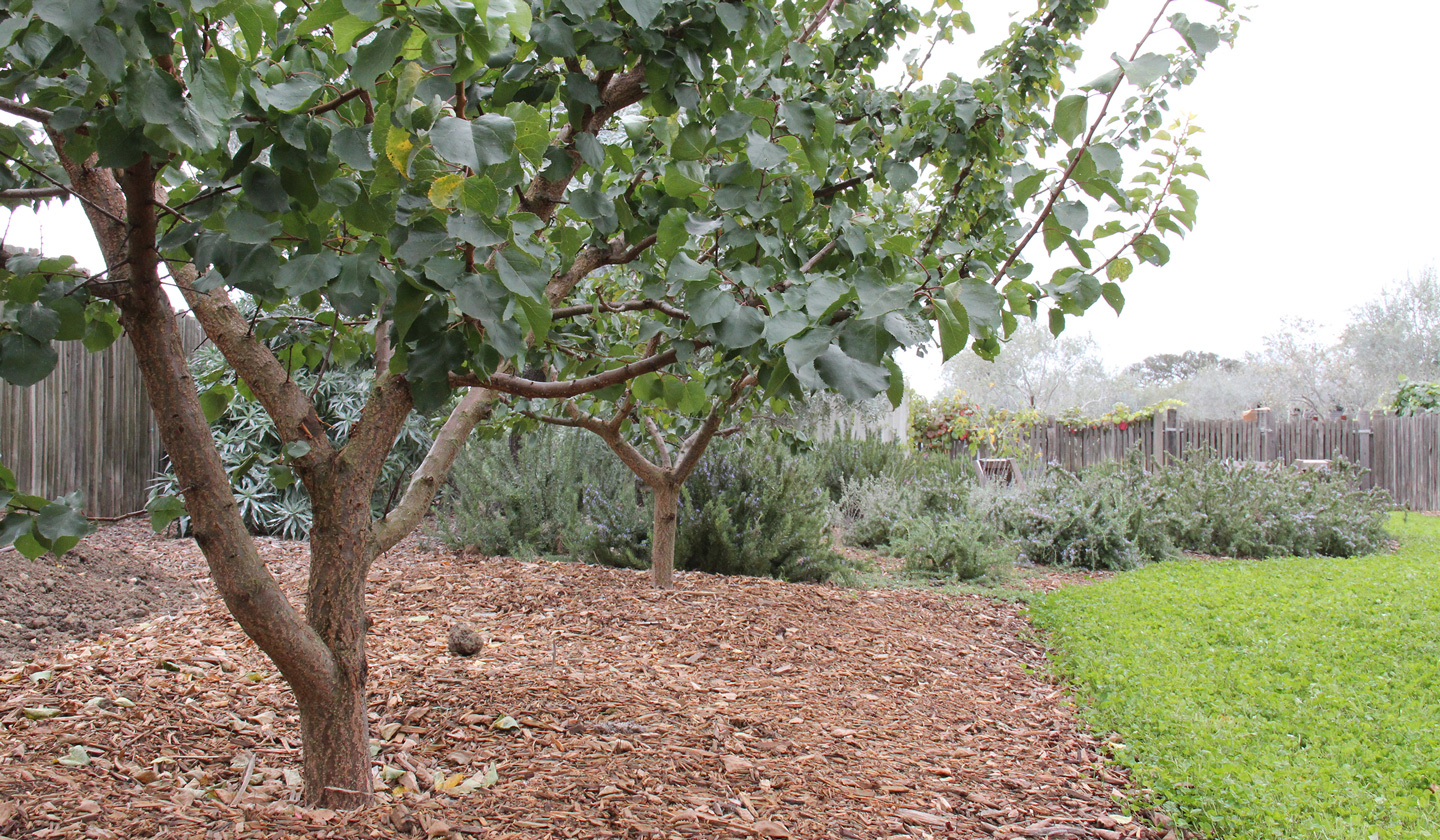
During your fruit tree's first year in the ground, it is very important that it grows well. What is 'well'? In essence, you are trying to double or triple the tree's size; in the second year, once again you want to see the tree double or triple in size. This happens through proper watering, soil fertility management, and pruning (see below). Once the tree has grown to fill its allotted space, then we let it begin fruiting. In other words, knock off any fruit that forms on the tree during the first two years. I know this can be hard on the psyche, but the gifts of patience are plentiful. Fruiting uses up essential nutrients that the tree needs to form a strong structural foundation, which will enable it to bear more fruit later on. So, for the entire first 2 years we give the tree as much strength to grow as we possibly can.
First year care calendar
|
Branched trees:
There are many training styles, but here we will discuss 2 different tree forms:
Open Center (for all stone fruit, apples, or pears)

This form is one of the easiest to create with your fruit trees. It consists of 3-6 primary branches growing
from the trunk at 65 degree angles, creating an open center or vase form. Each primary branch will be spaced horizontally from its neighbor to ensure easy light penetration and picking.
Modified Central Leader (apples and pears)
This form consists of multiple teirs of branches. With the lower tier always growing wider than the top tier, it forms a pyramidal shape. We recommend growing 2 tiers with the bottom tier consisting of 5-8 branches and the top tier consisting of 3-5 branches. Growing a third tier usually starts to get a little tall. The bottom tier's branches will extend 5-7' from the trunk, while the upper tiers branches will extend 2-4' from the trunk. The beauty of this form is that 70-80% of your yield will come from the lower tier, and only 20-30% in your upper tier. This means less ladder work! Make sure that you create a 2' gap in between tiers where there are no branches coming from the trunk. This will ensure greater light penetration to the lower branches.
Training:
Don't worry if your branches are in the wrong place, train them young, when they are very malleable, to grow in the direction you wish by using string and stakes, or a spreader.
![]() |
![]() |
Follow below for a step by step guide for pruning your newly planted tree:
Open Center Tree Form
-When choosing a tree, look for multiple branches moving away from the trunk at a 65 degree angle.
-More branches equals more options for you to choose your main 3-6 scaffold branches.
-Don't worry if you can't find a multi-branched tree; once in the ground, the tree will grow the branches it needs.
-Remove all unwanted branches so all that remain are the chosen 3-6 primary branches.
-In general, head back each primary branch by 1/2 its length.
-If the tree is small and has thin branches, head back each primary 3/4 of its length; if the tree is robust and thick, head it back 1/4 of its length. Remember that the more you cut, the more it will grow.